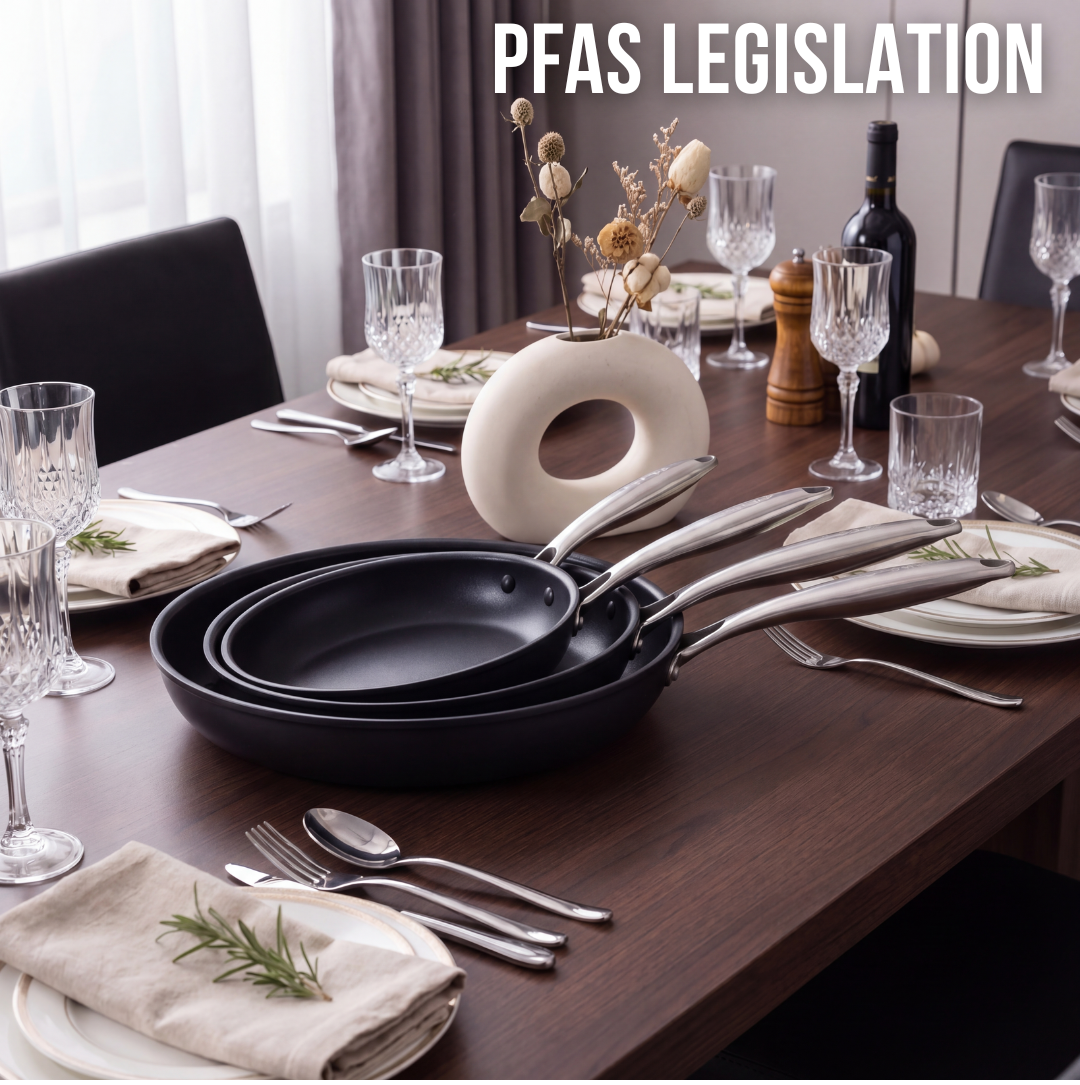
BHETA is advising members to review where PFAS may appear in their products and supply chains, following growing political and regulatory interest in so-called “forever chemicals” in the UK and Europe.
PFAS stands for per- and polyfluoroalkyl substances. They are a large family of chemicals used for properties such as non-stick, grease-resistant, water-resistant and stain-resistant performance. They have been used in a wide range of consumer and industrial products, including non-stick cookware, bakeware, food-contact packaging, treated textiles, coatings and surface-protection products.
There is currently no blanket UK ban on PFAS in cookware or housewares. However, the direction of travel is changing. The House of Commons Environmental Audit Committee has called for stronger Government action on PFAS, including restrictions on non-essential uses in consumer products such as cookware, food packaging and school uniforms. The Committee has suggested that a phased approach could begin from 2027.
The Committee has also encouraged Government to move away from regulating only individual substances and towards a wider approach. This could include clearer rules on essential use, supply-chain disclosure, labelling and environmental clean-up.
BHETA believes this is an important issue for members in the housewares, small electricals, DIY and garden sectors. Product categories potentially affected could include non-stick cookware, bakeware coatings, small electrical appliances with coated food-contact surfaces, grease-resistant packaging, baking liners, stain-resistant or water-resistant textiles, protective sprays, cleaning products and treated surfaces.
The issue is also likely to become high profile and more commercially significant. Retailers and customers may ask more detailed questions about PFAS before any new legislation is introduced. Members may increasingly be asked to provide declarations, testing evidence, or confirmation that products contain no intentionally added PFAS.
It is also important to note that “PFOA-free” does not necessarily mean “PFAS-free”. PFOA is only one substance within the wider PFAS family, and regulators are now looking at broader definitions.
UK and EU alignment could increase the pace of change
Members should also be aware of the possibility of closer UK alignment with EU chemicals regulation.
Recent reporting from The Chemical Engineer highlighted comments from Government officials indicating that the UK may use EU chemicals rules as a starting point for UK REACH, and only move away from them where there is a clear reason to do so. The same report noted that closer alignment could help avoid unnecessary duplication of EU chemical assessments.
This matters because the EU is already moving more quickly in some areas of PFAS regulation. EU rules and proposals may therefore become increasingly relevant to BHETA members, especially those selling into the EU or Northern Ireland, supplying major retailers, or working with customers who use EU rules as their compliance benchmark.
This does not mean that every EU PFAS measure will automatically become UK law. However, it does suggest that BHETA members should not assume that Great Britain will remain on a much slower or entirely separate path.
What BHETA is doing
BHETA is monitoring developments closely and is in contact with Government and relevant stakeholders on behalf of members.
BHETA’s position is that any future regulation must be clear, evidence-based, proportionate and workable for suppliers. It must also recognise the legitimate environmental and public-health concerns that are driving the debate.
The Association will seek clarity on:
- which PFAS definitions Government intends to use;
- which product categories are likely to be prioritised;
- whether cookware, bakeware, small electrical appliances, textiles, coatings and packaging will be treated differently;
- what transition periods may be proposed;
- how claims such as “PFAS-free” or “no intentionally added PFAS” should be evidenced;
- how the UK will avoid unnecessary divergence from EU and Northern Ireland requirements;
- how any new rules will be enforced fairly, including against online marketplaces and overseas sellers.
BHETA is considering setting up a PFAS Working Group. if you, or anyone in your business, would be interested in joining such a Group, please contact Will Jones (wj@bheta.co.uk).
What members should consider now
BHETA recommends that members begin a practical review of their own product ranges and supply chains.
Priority areas include:
- non-stick cookware and bakeware;
- coated food-contact surfaces in small electrical appliances;
- food-contact packaging, grease-resistant papers, liners and wrappers;
- stain-resistant, water-resistant or grease-resistant textiles;
- protective sprays, surface treatments and coatings;
- products currently making “PFOA-free”, “PFAS-free”, “fluorine-free” or similar claims.
Members may wish to start asking suppliers for written declarations confirming whether PFAS are intentionally added, whether fluoropolymers are present, and what technical or testing evidence is available.
It will also be important to understand whether products, components or packaging are supplied into the EU or Northern Ireland, where regulatory requirements may develop differently or sooner.
BHETA members should consider if they want to send a member to a potential PFAS Working Group. if you are interested, please contact Will Jones (wj@bheta.co.uk).
BHETA will continue to brief members
BHETA will continue to keep members updated and will represent member interests in any relevant Government consultation or regulatory process.
Members with specific concerns, technical questions or examples of likely commercial impact are encouraged to contact BHETA. Real-world member evidence will be important in helping the Association represent the sector effectively.
Steve Richardson, General Manager of BHETA, said:
“PFAS is clearly moving up the political and regulatory agenda, and members should be aware of the potential implications for housewares, small electricals, packaging and treated products. This is not a moment for panic, but it is a moment for preparation.
“BHETA is engaging with Government to ensure that any future rules are practical, proportionate and based on clear evidence. We will also be making the case for realistic transition periods, clarity on definitions and testing, and fair enforcement across the whole market, including overseas sellers and online marketplaces.
“Our advice to members is to start mapping potential PFAS exposure in products and packaging now, and to speak to BHETA if they have examples of where regulation could create technical, commercial or supply-chain challenges.”

.png)



.jpg)